Sunday, August 4, 2019

Economic Development: Economic uncertainty, geopolitical tensions stall growth in Latin America and Caribbean region, UN says


31 July 2019

Launching the Economic Survey of Latin America and the Caribbean 2019 at a press conference in Santiago, Chile, ECLAC Executive Secretary Alicia Bárcena pointed to “less momentum from world economic activity and global trade; greater volatility and financial fragility; questioning of the multilateral system; and an increase in geopolitical tensions” as the reasons driving the downward-looking forecast.

According to the report, an unfavorable international scenario will spark a drop in the region’s growth to 0.5 per cent this year – lower than the 0.9 per cent registered in 2018.


Likewise, low internal growth is attributed to a lack of momentum in investments and exports as well as a fall in public spending and private consumption.

Compared to previous years, the 2019 slowdown will affect 21 of the 33 countries in the region.

On average, South America is expected to grow by 0.2 per cent, Central America 2.9 per cent and the Caribbean 2.1 per cent.

The 2019 Survey cited restricted fiscal space that is fueled by insufficient income levels to cover spending that translates into deficits and debt increases in recent years.

Moreover, growing foreign exchange volatility and greater depreciation will limit central banks in the region to deepen policies to stimulate aggregate demand.

Additionally, structural conditions accentuate external vulnerability and do not help to spur growth – as the export structure focused mainly on primary goods and falling trend in productivity.

According to ECLAC, policy space needs to be expanded to tackle the slowdown and contribute to economic growth, with measures in the fiscal and monetary areas, as well as in investment and productivity.

In the fiscal arena, the survey cites the need to reduce tax evasion and illicit financial flows; promote taxes related to the digital economy, environment and public health; and realign tax expenditures toward productive investment.
Structural changes

The second part of the Economic Survey 2019 analyzes the structural changes in international finance subsequent to the 2007-2008 global crisis – from a regional perspective.

The report suggests that the bond market has gained relative importance with respect to the banking system and that levels of concentration, interconnectivity and pro-cyclicality have intensified. In addition, global debt registers record low levels of 320 per cent of gross domestic product in a context of growth.

To tackle these challenges, the report recommends expanding and standardizing of vulnerability indicators.

It also advocates advancing toward broader and more homogeneous macro-prudential regulation to encompass not only the formal banking sector but also all financial agents, including the so-called “shadow banking system”, in which groups of financial intermediaries facilitate in creating credit across the global financial system.


https://news.un.org/en/story/2019/07/1043531
Citing “an external context of greater uncertainty and growing complexity”, the head of the UN Economic Commission for Latin America and the Caribbean (ECLAC), said on Wednesday that the region’s economic growth is expected to decline.

Friday, July 19, 2019

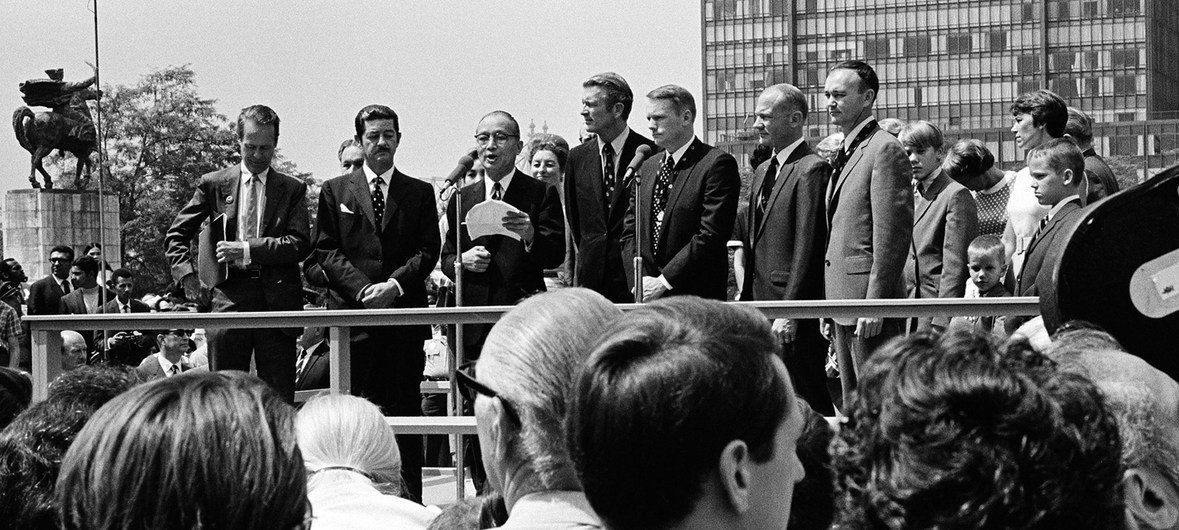
Culture:Neil Armstrong, Buzz Aldrin, and Michael Collins ‘came in peace’ to UN Headquarters ‘for all mankind’ 13 August, 1969, when the first men to land on the moon appeared in the main plaza of the UN General Assembly building, welcomed by the Secretary General at the time, U Thant, as “three great pioneers” on behalf of the entire human race


UN Photo/J. Grinde
American astronauts Neil Armstrong, Col. Edwin E. Aldrin, Jr. and Col. Michael Collins of Apollo 11, the first men to land on the moon, visited the United Nations where they attended a ceremony in their honour at the North Plaza of the United Nations General Assembly Building. (13 August 1969)


19 July 2019
Culture and Education


As the world remembers Saturday’s 50th anniversary of the “giant leap for mankind” made by all those involved in the pioneering Apollo 11 space programme, we take a look back at the visit made by astronauts Neil Armstrong, Buzz Aldrin, and Michael Collins, to UN Headquarters in New York, just a few weeks after their historic mission.


It was a sunny day on 13 August, 1969, when the first men to land on the moon appeared in the main plaza of the UN General Assembly building, welcomed by the Secretary General at the time, U Thant, as “three great pioneers” on behalf of the entire human race.

Standing on a special outdoor podium, notably lacking any women in the front row, the Burmese UN chief – the first non-European to hold the position – hailed the heroes of the United States’ Apollo 11 moon landing programme as having “already taken their place in that select roster of men, who down through the centuries have demonstrated the power of man’s vision, man’s purpose, and man’s determination.”


I can tell that you share with us, the hope that we citizens of earth, who can solve the problems of leaving earth, can also solve the problems of staying on it - Commander Neil Armstrong at UN Headquarters

He told the crowd of delegates, diplomats, UN staff and journalists gathered there, that the whole human race had been able to share in their “great achievement” with everyone who had watched or listened, participating in a truly “unique moment in history”.

Watching the astronauts walking on the moon had “helped us vicariously to satisfy the age-old longing to get away from it all”, he quipped and the extraordinary flight, moonwalk and return to earth had “brought to us a renewed realization of what we, as members of the human race, can accomplish on this planet, with our resources and our technology, if we are prepared to combine our efforts and work together for the benefit of all mankind.


Building on the theme of the power of collective effort, exemplified by the UN Charter, the Secretary-General said it was “particularly gratifying to me, that the plaque which the astronauts placed on the moon is inscribed: ‘we came in peace for all mankind’. The words are few, but they spell out the common identity of all the inhabitants on this planet and our never-ending search for peace”.

Taking the microphone, Commander Neil Armstrong, who uttered the immortal words “The Eagle has landed” as the lunar module touched down on the surface, addressed the crowd to warm applause as: “Distinguished representatives from the planet earth”.

He said it was “with great pride that we accept the honour of having the opportunity of seeing your warm smiling faces today” accepting on behalf of all the hundreds of dedicated scientists and NASA professionals involved in the Apollo programme, “your gracious words”.

His closing remark that day, was an eloquent testimony to the scale of their achievement, and the ambition of the whole United Nations: “I can tell that you share with us, the hope that we citizens of earth, who can solve the problems of leaving earth, can also solve the problems of staying on it”.

The astronauts brought an exact replica with them to the UN of the plaque left on the moon’s surface by them, engraved with the words: “Here men from the planet Earth set foot upon the Moon, July 1969. We came in peace, for all mankind.”

Another treasured memento of the Apollo mission, stored at UN Headquarters, ins a sample of lunar rock, gifted by former US President Richard Nixon, on July 20, 1970 when the international community celebrated the first anniversary of the lunar landing.

The three astronauts returned once more that day, to participate in a ceremonial handover of the moon relic.
Listen below to the address from UN chief U Thant, and Neil Armstrong, as the three astronauts and their familes were honoured at UN Headquarters in August 1969. Audio courtesy of our UN Audiovisual Library.


♦ Receive daily updates directly in your inbox - Subscribe here to a topic.

Thursday, May 16, 2019

fCAT: 4 key measures that Governments should prioritize in order to reach carbon neutrality by 2050 -UN Sec Gen

12 May 2019
Climate Change


Speaking to young Māoris and people of the Pacific islands in New Zealand, UN Secretary-General António Guterres said “nature does not negotiate” and emphasized four key measures that Governments should prioritize in order to reach carbon neutrality by 2050.


Acknowledging the role that youth needs to play in advancing climate action worldwide, he reminded the room of our common “central objective: not to have more than 1.5 degrees of increasing temperature at the end of the century. The international community, and especially the scientific community, has been very clear that to reach this goal we absolutely need to have carbon neutrality by 2050.”

For this, he called on nations worldwide to make four pivotal shifts:

1. Tax pollution, not people

The UN chief called for an emphasis to be placed on taxes on carbon emissions, known as “carbon pricing,” instead of being placed on salaries.
2. Stop subsidizing fossil fuels

He stressed that taxpayer money should not be used to increase the frequency of hurricanes, the spread of drought and heatwaves, the melting of glaciers and the bleaching of corals.
3. Stop building new coal plants by 2020

Coal-based power is key according to UN-environment’s 2018 Emissions Gap Report: all plants currently in operation are committing the world to around 190 giga tonnes of CO2, and if all coal power plants currently under construction go into operation and run until the end of their technical lifetime, emissions will increase by another 150 giga tonnes, jeopardizing our ability to limit global warming by 2°C as agreed upon in the 2015 Paris Agreement.
4. Focus on a green economy not a grey economy

“It is very important that around the world young people, civil society and those that in the business community have understood that the green economy is the economy of the future and the grey economy has no future,” said Mr. Guterres. “It’s very important that you convince governments that they must act because there’s still a lot of resistance,” he told the youth gathered in the room.

“Governments are still afraid to move forward,” he deplored explaining that “they feel the costs of climate action forgetting that the costs of inaction are much bigger than any costs of climate action”.

“Nature does not negotiate,” he added. “It’s very good to see youth in the frontline.”

On 23 September, the UN chief is convening a Climate Change Summit to galvanize increased ambition for decisive climate action.

Monday, March 25, 2019

‘Global clarion call’ for youth to shape efforts to forge peace in the most dangerous combat zones -UN


UN Youth Envoy/Nikke Puskala
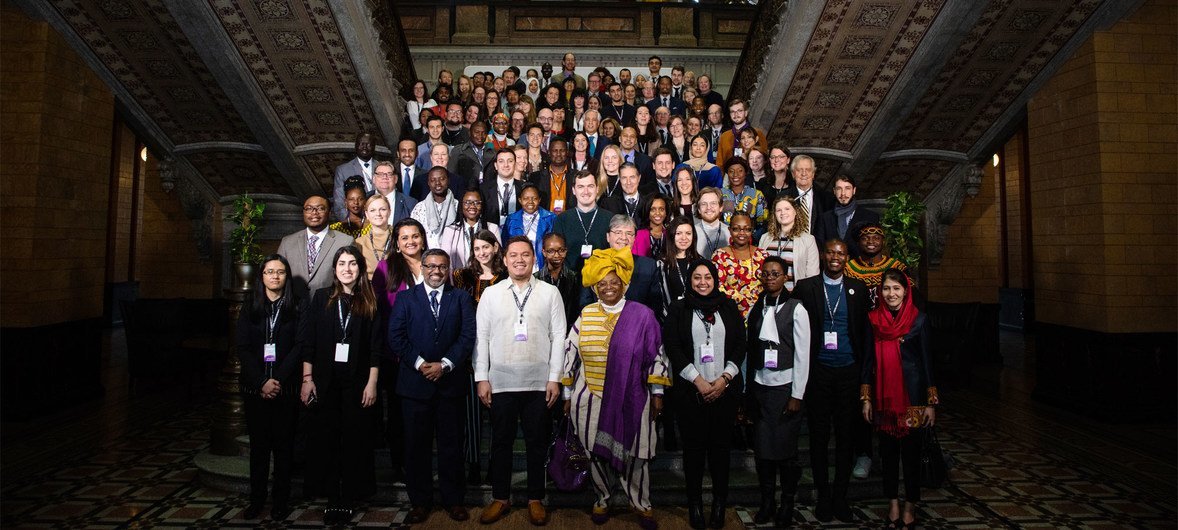
First International Symposium for Youth Participation in Peace Processes takes place in Helsinki, Finland. March 2019

Peace and Security
For the first time ever, youth from the frontlines of conflict have joined mediators, researchers and Government representatives at an international conference, to discuss new and innovative ways for young people to contribute to peace processes.


The First International Symposium on Youth Participation in Peace Processes concluded in Helsinki, Finland, with a global policy paper, according to reports, that aims to integrate their efforts, interventions and contributions towards sustaining the search for peaceful solutions to conflict.

In her keynote address, General Assembly President Maria Fernanda Espinosa highlighted Youth, Peace and Security as one of her seven priorities.


She called young people “agents of change” and outlined examples in which they have helped foster inter-communal dialogue, such as in Kenya, and consolidate peace, such as in Sierra Leone, Liberia and other countries.

Ms. Espinosa also addressed the importance of gender equality, decent work and the support for young migrants and refugees.

The General Assembly President concluded by underscoring that the world must improve youth participation in national and international decision-making and encouraged Member States to embrace young people in their delegations and to work closely with the Office of the Secretary-General's Youth Envoy, Jayathma Wickramanayake.

With over half of the world’s population under-30 and an estimated 600 million youth living in fragile and conflict-affected States, it is apparent that young people must engage in conflict prevention and mediation processes – a domain where they are often marginalized.

"Young people account for a considerable share of people living in the developing world and in conflict areas but they are often left outside of the scope of all decision-making in society, including peace processes”, said Timo Soini, Foreign Minister for Finland, one of the governments co-hosting the event.

For her part, the Youth Envoy called the Symposium “the global clarion call for a collective response in bringing voice and credibility to young people on the frontlines actively leading efforts to shape peace processes”.

Considering their sheer numbers and vital force, young people are key participants in development, democracy, peace-sustaining initiatives and peacebuilding interventions. As such, they must be empowered as decision makers to actively and meaningfully contribute to peace processes that affect their lives, according to the UN Envoy’s office.

“Young people are bridges”, said youth participant Leonardo Parraga. “They play a key role in connecting local actors like civil society organizations, with decision-making actors that have a seat inside the room”.

At the two-day Symposium ending on Wednesday, inter-generational participants exchanged views and best practices on involving young people in both formal and informal peace processes. Youth attendees, moderated, facilitated and acted as rapporteurs throughout all plenary discussions and working groups.

Noting “progress in advancing the Youth, Peace and Security agenda" Ms. Wickramanayake asserted: "We cannot stop now”.

The event was co-hosted by the Governments of Finland, Qatar, and Colombia, and co-organized by the office of the UN’s Youth Envoy and Search For Common Ground in partnership with the UN Department of Political and Peacebuilding Affairs, UN Population Fund, UN Development Programme and the United Network of Young Peacebuilders.

Sunday, March 24, 2019

Tuesday, February 19, 2019

UN chief hails victory of ‘political will’ in historic Republic of North Macedonia accord


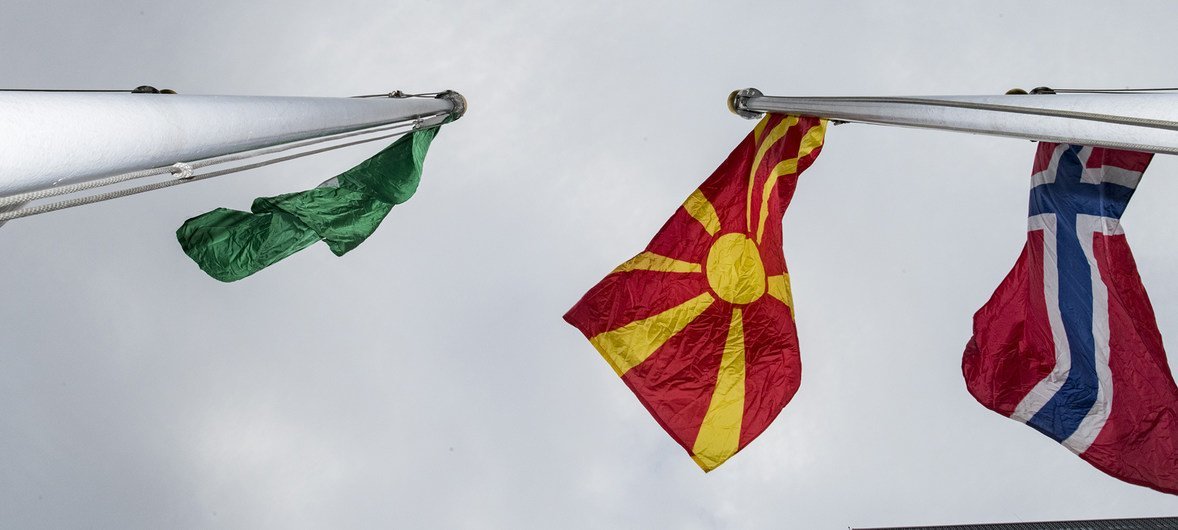
UN Photo/Mark Garten
North Macedonia flag raising for the first time at UN Headquarters in New York. The flag is alphabetically located between the flags of Nigeria (left) and Norway (right).


14 February 2019
UN Affairs


The UN-brokered agreement between Athens and Skopje to formally recognize the “Republic of North Macedonia”, is a welcome, “historical” step that should be supported by regional and international Member States, António Guterres has announced.


In a statement following on from the entry into force of the Prespa Agreement between the two countries on Tuesday, the UN Secretary-General confirmed that he had received official notification of the development, which settles a near 30-year dispute between the two neighbours.

Mr. Guterres congratulated the two sides and Prime Ministers Alexis Tsipras, of Greece, and Zoran Zaev, of North Macedonia, “on their determination in creating a forward-looking vision for relations between the two countries and reconciliation in the Balkan region and beyond”.

He added that he was “deeply grateful” to the UN’s longest serving envoy Matthew Nimetz of the United States, for his “unwavering commitment and dedication” in pursuing the deal.

On Thursday afternoon, the UN Protocol and Liaison Service announced the official switch over within the UN, from the former Yugoslav Republic of Macedonia, to the new name of North Macedonia. The official long version of the name will be Republic of North Macedonia.

Secretary-General António Guterres on the Prespa agreement.
Name-change deal solves ‘seemingly intractable’ split

The Prespa Agreement was signed by both countries on 17 June last year and ratified by their parliaments last month. It demonstrates that “even seemingly intractable issues can be resolved through dialogue and political will”, Mr. Guterres insisted.

Negotiations on the name dispute began in 1993 and have been led by the UN Secretary-General’s Personal Envoy Mr. Nimetz since 1999.

Saturday, February 9, 2019

Tanzania the “regional peacemaker” of Africa for the long-standing welcome it offers hundreds of thousands of refugees- UNHCR

Speaking at the end of a four-day visit to the east African nation, Filippo Grandi called for greater investment in the north-west region of Tanzania, where some 300,000 refugees are being hosted, and pledged to mobilize more support for humanitarian efforts, local community development, improved camp security, and environmental projects.

In a meeting with Tanzanian President John Joseph Magafuli, Mr. Grandi commended the country’s tradition of welcoming refugees fleeing conflict and persecution in neighbouring countries, and said Tanzania deserved greater international recognition for its role as “one of the most important refugee asylum countries in Africa.”

However, Mr. Grandi also impressed upon government officials the importance of not forcing refugees to go back to their countries of origin. Over 57,000 refugees from Burundi have been assisted to voluntarily leave Tanzania and return home in the last two years, but some refugees report their decision was partly based on perceived pressure from the authorities, restrictions on freedom of movement and a lack of access to jobs, so they can support themselves.

“It is important that nobody is forced back, that repatriation remains a voluntary exercise,” Mr. Grandi told reporters, after visiting the Nyarugusu Refugee Camp in Kasulu, home to around 15,000 Burundian and Congolese refugees. He noted that some refugees are volunteering to go back to their countries of origin, despite uncertain conditions in both the Democratic Republic of Congo (DRC) and Burundi, and said that sustainable refugee return happens when refugees feel confident that it is safe to go back, and receive the necessary support to do so. Nearly three-quarters of Tanzania’s refugees are from Burundi, and the other 26 per cent are from the Democratic Republic of the Congo, or DRC.

Mr. Grandi praised Tanzania for supporting the UN’s Global Compact on Refugees, which calls for greater international support to host countries and more refugee self-reliance which, he said, stimulates local economies and provides opportunities for host communities.

Sunday, January 20, 2019

Yemen Hodeidah Agreement: Lifeline for millions of Yemenis on the verge of starvation. Security Council backs new mission in support of key port city truce

Peace and Security

The Security Council unanimously voted in favour of deploying up to 75 observers to monitor a fragile ceasefire in Yemen's port city of Hudaydah which went into effect late last month; a lifeline for millions of Yemenis on the verge of starvation.


Among other things, the newly adopted resolution establishes what will be officially known as the UN Mission to support the Hodeidah Agreement (UNMHA).

Last month, after UN-brokered consultations in Sweden aimed at getting the warring sides together to end nearly four years of brutal civil war, the Houthi movement leadership and Yemeni Government representatives, signed the Hodeidah Agreement.

The resolution sets out, for an initial six months, an increase from around 20 observers already in place to monitor the ceasefire, up to 75, positioned in and around the Red Sea port, where Yemen’s receives most of its commercial goods and lifesaving aid.


The new special political mission will support the implementation of the December Stockholm Agreement, consisting of three separate pledges between the two sides: halting hostilities in Hudaydah and mutually redeploying forces from the city and the ports, Salif and Ras Issa; a prisoner exchange mechanism; and a statement of understanding on the city of Taiz, where fighters have wrestled for control for years now.

According to news reports, both Houthi rebels and the UN-backed Government have accused each other of multiple ceasefire breaches, calling the terms flawed because they lacked precision. Adding more monitors, will allow for more accurate assessment.

Retired General Patrick Cammaert, chairs the Redeployment Coordination Committee (RCC), and in accordance with the Security Council resolution, will now head up UNMHA, reporting to the Secretary-General through Special Envoy for Yemen, Martin Griffiths.

The UN Mission to support the Hodeidah Agreement (UNMHA) will:

Lead and support the Redeployment Coordination Committee to oversee the governorate-wide ceasefire, redeployment of force and mine action operations;

Monitor compliance to the ceasefire in Hodeidah governorate and the mutual redeployment of forces from the city of Hodeidah and the ports of Hodeidah, Salif and Ras Issa.
Work with the parties to secure the city of Hodeidah and the ports of Hodeidah, Salif, and Ras Issa in accordance with Yemeni law.
Facilitate and coordinate UN support to assist the parties to fully implement the Hodediah Agreement.


The RCC includes Yemen government representatives and Houthis, to supervise implementation of the Stockholm Agreement. The UN advance team has already been working with the RCC on monitoring and supporting implementation.

The UK-sponsored resolution requests the Secretary-General to report to the Council on a monthly basis on the resolution’s implementation and to present it with a review of UNMHA in five months’ time.
https://news.un.org/en/story/2019/01/1030582

Friday, January 18, 2019

Warning From Man Who Designed RFID Microchip


Carl Sanders sat in seventeen New World Order meetings with heads-of-state officials such as Henry Kissinger and Bob Gates of the C.I.A. to discuss plans on how to bring about this one-world system. The government commissioned Carl Sanders to design a microchip for identifying and controlling the peoples of the world—a microchip that could be inserted under the skin with a hypodermic needle (a quick, convenient method that would be gradually accepted by society).

Carl Sanders, with a team of engineers behind him, with U.S. grant monies supplied by tax dollars, took on this project and designed a microchip that is powered by a lithium battery, rechargeable through the temperature changes in our skin. Without the knowledge of the Bible (Brother Sanders was not a Christian at the time), these engineers spent one-and-a-half-million dollars doing research on the best and most convenient place to have the microchip inserted.

Guess what? These researchers found that the forehead and the back of the hand is not just the most convenient place, but is also the only viable place for rapid, consistent temperature changes in the skin to recharge the lithium battery. The microchip is approximately seven millimetres in length, .75 millimetres in diameter, about the size of a grain of rice. It is capable of storing pages upon pages of information about you. All your general history, work history, crime record, health history, and financial data can be stored on this chip.

Brother Sanders believes that this microchip, which he regretfully helped design, is the “mark” spoken about in Revelation
13:15–17. The original Greek word for “mark” is “charagma,” which means a “scratch or etching.” It is also interesting to note that the number 666 is actually a word in the original Greek. The word is “chi xi stigma,” with the last part, “stigma,” also meaning “to stick or prick.”

In light of these definitions, implantable microchips could very well be the physical mark spoken of in the Book of Revelation.

Sunday, January 13, 2019

PEACE VIGIL: UN Headlines January 1-31, 2019 from UN News Cente...

PEACE VIGIL: UN Headlines January 1-31, 2019 from UN News Cente...: CICIG UN anti-corruption body in Guatemala rebuts government’s reasons for expulsion order 12 January 2019 Law and Crime Prevention ...