Thursday, July 26, 2018

PRAYERS FOR PEACE: PRAY FOR SYRIA for the protection of civilians and...

PRAY FOR SYRIA for the protection of civilians and civilian infrastructure and sparing them the brunt of violence and conflict wherever they are

26 July 2018
Peace and SecurityThe United Nations Secretary-General António Guterres, has strongly condemned multiple suicide bombings on Wednesday in the government-held town of Sweida, in Syria’s south-west, which killed and injured scores of civilians.According to news reports, the attacks were claimed by the terrorist group ISIL, or Da’esh, which has been defending territory in the region from a major government offensive.

“He is appalled by the utter disregard for human life displayed by ISIL,” said UN Spokesperson Stéphane Dujarric, stressing that “those responsible for the attacks must be held accountable”.

The Secretary-General extended his condolences to the families of the deceased and wishes the injured a speedy recovery.

The UN Humanitarian Coordinator for the region, Ali al-Za’tari called for better “protection of civilians and civilian infrastructure and sparing them the brunt of violence and conflict wherever they are” in the war-torn country.

Staffan de Mistura, the UN Special Envoy for Syria who is attempting to bring the warring parties to the negotiation table, briefed the Security Council on Wednesday behind closed doors from Geneva, on the latest political and humanitarian situation.

news source: https://news.un.org/en/story/2018/07/1015582


PRAYERS FOR PEACE: PRAY FOR SYRIA for the protection of civilians and...: 26 July 2018 Peace and Security The United Nations Secretary-General António Guterres, has strongly condemned  multiple suicide bombings on...

PRAYERS FOR PEACE: PRAY FOR PAKISTAN as suicide attack killed dozens ...

PRAY FOR PAKISTAN as suicide attack killed dozens near polling station

The suicide bombing that killed at least 31 people and injured another 70 was claimed by the ISIL, or Da’esh terrorist group, according to news reports. The country has been witnessing outbursts of violence across the country in the lead-up to Wednesday’s parliamentary and provincial assembly elections.

The elections mark only the second time that one civilian government has handed on power to the other, after serving a full term in office.

“The Secretary-General condemns the suicide attack at a polling station in Quetta claimed by Da’esh,” said Spokesperson Stephane Dujarric in a statement. “He extends his heartfelt condolences to the families of the victims and to the Government and people of Pakistan.”


Despite the violence, news outlets reported that millions of Pakistanis showed up to cast their vote. The 85,000 polling stations closed on Wednesday by 7 pm, local time.

The UN Spokesperson stressed that “the United Nations stands in solidarity with, and supports the efforts of the Government of Pakistan, in the fight against terrorism.”

The President of the UN General Assembly, Miroslav Lajčák, also condemned the attack, which he called “despicable”.

The suicide bombing in Quetta followed on from a series of terrorist attacks earlier in the month, including one in Mastung, in which 153 people lost their lives.

news source: https://news.un.org/en/story/2018/07/1015542

PRAYERS FOR PEACE: PRAY FOR PAKISTAN as suicide attack killed dozens ...: The suicide bombing that killed at least 31 people and injured another 70 was claimed by the ISIL, or Da’esh terrorist group, according to ...

Monday, July 23, 2018

PRAYERS FOR PEACE: PRAY FOR NICARAGUA to end killing of demonstrators...

PRAY FOR NICARAGUA to end killing of demonstrators and seek a political solution

The United Nations Secretary-General has called on the Nicaraguan Government to end violence against demonstrators which has cost an estimated 280 lives, and begin a national “political dialogue” to end the crisis which has gripped the country for nearly three months.
Speaking in neighbouring Costa Rica on Monday night, António Guterres said that it was “an essential responsibility of the State to protect its citizens, and this basic principle cannot be forgotten, especially when, unfortunately, we have a death toll that is absolutely shocking.”
At least 12 people were killed over the weekend, mostly as police and paramilitary supporters of the government confronted demonstrators who have been protesting proposed reforms to the pension system across the country, since 18 April. Protesters are demanding that the long-serving President, Daniel Ortega, step down.
The UN chief told reporters on Monday that “it is essential that violence must stop immediately and that the political dialogue, the national dialogue, be revitalized because only a political solution is acceptable for Nicaragua.”
Mr. Guterres said that he was “not a supporter of simplistic analysis of complex problems, but there is one thing that is obvious: there is a death toll that is shocking due to the use of force on the part of entities linked to the State, that is not acceptable.”
His words were amplified by the UN human rights office, OHCHR, on Tuesday in Geneva, where spokesperson Rupert Colville noted the “increasing climate of fear and mistrust” in the country and called for protesters’ safety to be guaranteed, along with their right to freedom of expression.
“The appalling loss of life must stop – now,” he said. “The violence is all more horrific as armed elements loyal to the government are operating with the active or tacit support of the police and other state authorities.”
PRAYERS FOR PEACE: PRAY FOR NICARAGUA to end killing of demonstrators...: The  United Nations Secretary-General  has called on the Nicaraguan Government to end violence against demonstrators which has cost an ...

PRAYERS FOR PEACE: PRAY FOR HAMAS and ISRAEL to ‘step back from the b...

PRAY FOR HAMAS and ISRAEL to ‘step back from the brink of another devastating conflict’ in Gaza

Voicing deep concern over the latest flare-up of violence around Gaza, the United Nations chief on Saturday urged all sides to “step back from the brink of another devastating conflict”.
“I am gravely concerned over the dangerous escalation of violence in Gaza and southern Israel,” said Secretary-General António Guterres in a statement.
“I deeply regret the loss of life. It is imperative that all sides urgently step back from the brink of another devastating conflict”, he added.
On 30 March this year, Palestinians in Gaza – controlled by Hamas, a militant Palestinian faction – started a mass protest against a blockade of the enclave imposed by Israel since the early 1990’s. The confrontation between the sides has since escalated.
On Friday, Palestinian gunmen killed an Israeli soldier and the Israeli military launched dozens of strikes that killed three Hamas fighters, according to media reports. A fourth Palestinian was killed by Israeli gunfire during a protest near the border.
In the statement, Mr. Guterres called on Hamas and other Palestinian militants in Gaza to cease the launching of rockets and incendiary kites and provocations along the enclave’s border fence. He also said Israel must exercise restraint to avoid further inflaming the situation.
“Any further escalation will endanger the lives of Palestinians and Israelis alike, deepen the humanitarian catastrophe in Gaza and undermine current efforts to improve livelihoods and support the return of the Palestinian Authority to Gaza,” he said.
The Secretary-General also encouraged all to engage with the UN, and particularly his Special Coordinator, Nickolay Mladenov, and work to find “a way out of this dangerous situation”. PRAYERS FOR PEACE: PRAY FOR HAMAS and ISRAEL to ‘step back from the b...: Voicing deep concern over the latest flare-up of violence around Gaza, the United Nations chief on Saturday urged all sides to “step ba...

Wellness for Peace Education on Climate Change: #fCAT: Dress the world in wood, UN says in its ‘Fo...

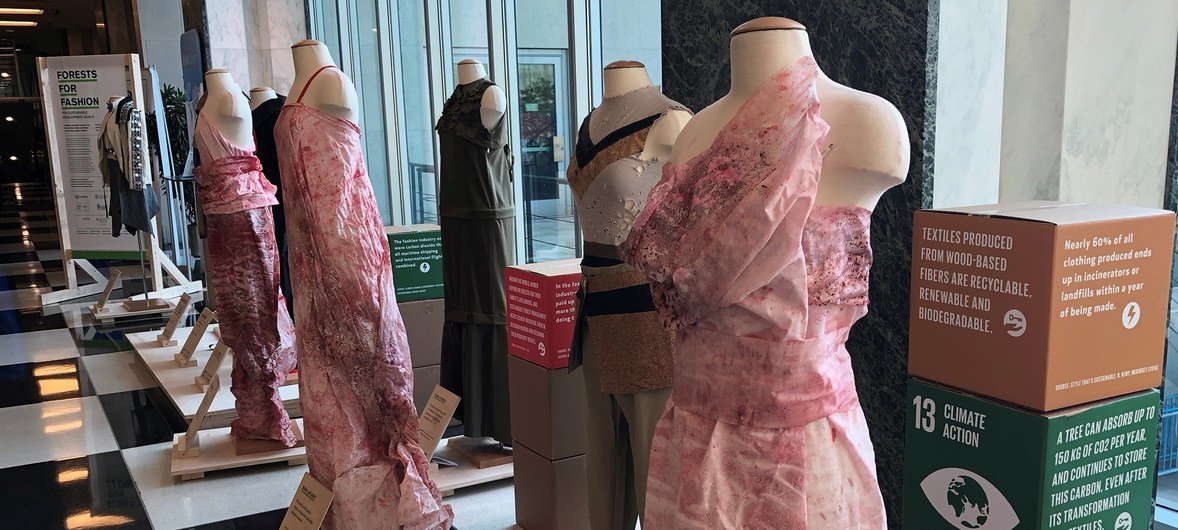
#fCAT: Dress the world in wood, UN says in its ‘Forests for #Fashion’ initiative

The fashion industry is valued upward of 2.5 trillion dollars, and employs some 75 million people globally – so it makes good sense to shift textile production from fossil fuel-based synthetic fibers to renewable, biodegradable textiles, made from wood, according to a new United Nations initiative that aims to make forests literally more fashionable.
The United Nations Economic Commission for Europe (ECE)-FAO’s (Food and Agriculture Organization) “Forests for Fashion” initiative, links forest-based materials from sustainably managed forests, with the world of fashion.
“Sustainability of a society is both an individual and a collective responsibility,” said UN Development Programme (UNDP) Goodwill Ambassador Michelle Yeoh, at UN headquarters on Monday.
“The fashion industry is responsible for producing 20 per cent of global waste water and 10 per cent of the global carbon emissions – more than the emissions of all international flights and maritime shipping combined,” said the star of the movie Crouching Tiger, Hidden Dragon.
In addition, the textiles industry has recently been identified as a major polluter, with estimates of around half a million tonnes of plastic microfibers ending up in the world’s oceans as polyester, nylon or acrylic are washed each year.
“Fashion is often a synonym of dangerous working conditions, unsafe processes and hazardous substances used in production,” she continued, citing the cruel abuses of modern slavery and child labour.
Although the 2030 Agenda for Sustainable Development and the Sustainable Development Goals (SDGs) are an ambitious blueprint for governments, Ms. Yeoh stressed that everyone must make a conscious choice to change habits and plan for the future.
“Today we count around 3.2 billion people in the global middle class,” she said. “By 2030, this number will rise to about 5.4 billion with the major part of the growth occurring in Asia. The 2.2 billion people entering the global middle class will aspire to a similar lifestyle as we know it today – which includes a similar consumption pattern with respect to clothing.”
UN News/Matt Wells
View of designs using textiles produced from wood-based fibers at the UN agencies backed exhibit

A fashion revolution

Calling fashion “a major development challenge,” Ms. Yeoh sees clothing as “an essential element for the transition towards sustainable societies.”
While acknowledging the need for governments’ involvement in shifting the fashion industry to in the right direction, she put the main onus on individuals to start the fashion “revolution”.
“Many of us would also think that forests are best left untouched, however is often by adding value to their products that we can best protect them, and in many cases restoration efforts can be coupled with productive forests,” she attested.
Moreover, forests can create productive ecosystems, to support local and rural communities. According to the UNDP envoy, ‘forest fibers are already a reality and textile businesses are growing or buying large forest extensions.”
“New fibers are highly sustainable, their carbon and ecological footprints are low, and there are different fast-growing species suitable for different places and climates,” she indicated.
“Let’s face it,” concluded Ms. Yeoh, “changing the production and consumption patterns of the fashion industry will have a domino effect on many aspects of development and provide a visible and meaningful contribution to the achievement of the 2030 Agenda.”
Wellness for Peace Education on Climate Change: #fCAT: Dress the world in wood, UN says in its ‘Fo...: The fashion industry is valued upward of 2.5 trillion dollars, and employs some 75 million people globally – so it makes good sense to ...

PRAYERS FOR PEACE: PRAY FOR YEMEN: Civilian casualties and mass displ...

PRAY FOR YEMEN: Civilian casualties and mass displacements continue to mount amidst intense fighting. Hudaydah – the primary gateway for food and humanitarian aid for a population on the verge of starvation

“The situation is very bad and we’re doing our best to provide them with temporary shelter and support for the time being,” said Stefano Pes, IOM Yemen’s Officer in Charge, noting that agency staff and partners are working in a difficult environment to deliver food, and non-food items, shelter kits and good quality tents.
Hudaydah – the primary gateway for food and humanitarian aid for a population on the verge of starvation – has been racked by fighting between Houthi rebels, who control the port, and government forces backed by a Saudi-led military coalition.
Civilian casualties and mass displacements continue to mount amidst intense fighting that began on 12 June.
It has caused further damage to public services which are stretched to the limit, affecting water supplies, forcing shops to close and resulting in shortages in essential commodities. This has complicated the delivery of humanitarian assistance and resulted in the closure of a temporary feeding centre in Zabid.
The fortunate few who are able to leave, are traveling to the relative safely of Sana’a, Aden and Thamar but the majority of the population have already exhausted their reserves, forcing them to seek protection wherever they can, said the agency.
About 50 IOM staff are working in various locations to assist migrants and an estimated 50,000 newly displaced Yemenis in Hudaydah. IOM has also provided 7,830 meals to children in three Hudaydah schools.
The crisis in Yemen has its genesis in the 2011 Arab Spring uprising, which swept across the country amid ongoing rebel insurgency. Although anti-Government protests led to the ouster of the then President, the transfer of power to Mr. Hadi, his deputy, led to further instability and conflict.PRAYERS FOR PEACE: PRAY FOR YEMEN: Civilian casualties and mass displ...: “The situation is  very bad  and we’re doing our best to provide them with temporary shelter and support for the time being,” said Stefano...

Wellness for Peace Education on Climate Change: E-Governance: A powerful tool to combat, mitigate ...

Wellness for Peace Education on Climate Change: E-Governance: A powerful tool to combat, mitigate ...: The  2018 E-Government Survey  highlights the complex challenges and varied opportunities of deploying e-government services. Contributi...


E-Governance: A powerful tool to combat, mitigate and sustainably manage disaster risks -UN

The 2018 E-Government Survey highlights the complex challenges and varied opportunities of deploying e-government services.
Contributing to the global report, the UN Economic and Social Commission for Asia and the Pacific (ESCAP) highlights that the use of information and communications technology during all phases of disaster risk management presents “substantial opportunities to reduce disaster risks, enhance coping capabilities, and provide inclusive preparedness and response.”
Several regional case studies illustrate that it is critical to integrate emerging innovations in digital technology, such as artificial intelligence (AI), social media, space applications and geospatial information for e-resilience efforts.
To ensure undisrupted services and information to citizens before, during and after disasters, the report also reiterates the urgency of embracing e-resilience in e-government initiatives.
The findings and recommendations come against the backdrop of several recent disasters, such as landslides in Japan, an unpresented heatwave in Pakistan and monsoon flash floods in Bangladesh and India, all of which serve to remind us how disaster risk is outpacing disaster resilience in Asia-Pacific.
As the Asia-Pacific region is among the world’s most disaster-impacted, governments have stepped-up disaster risk reduction efforts through digital connectivity and innovations. 
“Digitally-driven emerging frontier technologies, such as AI, are expected to offer unparalleled levels of data availability, insights and coping capabilities to support countries address this formidable challenge and advance the implementation of the Sustainable Development Goals (SDGs), said ESCAP.
Broadband connectivity for all remains critical to the success of e-governance. 
Towards this end, ESCAP continues to support the Asia-Pacific Information Superhighway initiative to seamlessly increase the regional availability, affordability and resilience of broadband networks as a platform for e-resilience.
Its implementation will be reviewed and discussed by countries and partners in Bangkok, from 27-28 August, followed by an ESCAP intergovernmental meeting of the Second Session of the Committee on Information and Communications Technology, Science, Technology and Innovation on 29 to 31 August 2018.

Sunday, July 22, 2018

PEACE VIGIL: UN Headlines July 1-21, 2018 from UN News Center

PEACE VIGIL: UN Headlines July 1-21, 2018 from UN News Center: LATEST NEWS UN Photo UN chief urges Hamas and Israel to ‘step back from the brink of another devastating conflict’ in Gaza 21 July 2018 Pea...

Saturday, July 21, 2018

Wellness Pilipinas International: Why is antimicrobial resistance a global concern? ...

Wellness Pilipinas International: Why is antimicrobial resistance a global concern? ...: Antimicrobial resistance is putting the gains of the Millennium Development Goals at risk and endangers the achievement of the Sustainable ...


Why is antimicrobial resistance a global concern? -WHO

Antimicrobial resistance is putting the gains of the Millennium Development Goals at risk and endangers the achievement of the Sustainable Development Goals. 
New resistance mechanisms are emerging and spreading globally, threatening our ability to treat common infectious diseases, resulting in prolonged illness, disability, and death.

Antimicrobial resistance increases the cost of healthcare with lengthier stays in hospitals and more intensive care required.

Without effective antimicrobials for prevention and treatment of infections, medical procedures such as organ transplantation, cancer chemotherapy, diabetes management and major surgery (for example, caesarean sections or hip replacements) become very high risk.


What accelerates the emergence and spread of antimicrobial resistance?
Antimicrobial resistance occurs naturally over time, usually through genetic changes. However, the misuse and overuse of antimicrobials is accelerating this process. In many places, antibiotics are overused and misused in people and animals, and often given without professional oversight. Examples of misuse include when they are taken by people with viral infections like colds and flu, and when they are given as growth promoters in animals or used to prevent diseases in healthy animals.

Antimicrobial resistant-microbes are found in people, animals, food, and the environment (in water, soil and air). They can spread between people and animals, including from food of animal origin, and from person to person. Poor infection control, inadequate sanitary conditions and inappropriate food-handling encourage the spread of antimicrobial resistance.


Key facts Antimicrobial resistance (AMR) threatens the effective prevention and treatment of an ever-increasing range of infections caused by bacteria, parasites, viruses and fungi.
AMR is an increasingly serious threat to global public health that requires action across all government sectors and society.
Without effective antibiotics, the success of major surgery and cancer chemotherapy would be compromised.
The cost of health care for patients with resistant infections is higher than care for patients with non-resistant infections due to longer duration of illness, additional tests and use of more expensive drugs.
In 2016, 490 000 people developed multi-drug resistant TB globally, and drug resistance is starting to complicate the fight against HIV and malaria, as well.

Antimicrobial resistance happens when microorganisms (such as bacteria, fungi, viruses, and parasites) change when they are exposed to antimicrobial drugs (such as antibiotics, antifungals, antivirals, antimalarials, and anthelmintics). Microorganisms that develop antimicrobial resistance are sometimes referred to as “superbugs”.

As a result, the medicines become ineffective and infections persist in the body, increasing the risk of spread to others.


Present situation
Resistance in bacteria

Antibiotic resistance is present in every country.

Patients with infections caused by drug-resistant bacteria are at increased risk of worse clinical outcomes and death, and consume more health-care resources than patients infected with non-resistant strains of the same bacteria.

Resistance in Klebsiella pneumoniae – common intestinal bacteria that can cause life-threatening infections – to a last resort treatment (carbapenem antibiotics) has spread to all regions of the world. K. pneumoniae is a major cause of hospital-acquired infections such as pneumonia, bloodstream infections, and infections in newborns and intensive-care unit patients. In some countries, because of resistance, carbapenem antibiotics do not work in more than half of people treated for K. pneumoniae infections.

Resistance in E. coli to one of the most widely used medicines for the treatment of urinary tract infections (fluoroquinolone antibiotics) is very widespread. There are countries in many parts of the world where this treatment is now ineffective in more than half of patients.

Treatment failure to the last resort of medicine for gonorrhoea (third generation cephalosporin antibiotics) has been confirmed in at least 10 countries (Australia, Austria, Canada, France, Japan, Norway, Slovenia, South Africa, Sweden and the United Kingdom of Great Britain and Northern Ireland).

WHO recently updated the treatment guidelines for gonorrhoea to address emerging resistance. The new WHO guidelines do not recommend quinolones (a class of antibiotic) for the treatment of gonorrhoea due to widespread high levels of resistance. In addition, treatment guidelines for chlamydial infections and syphilis were also updated.

Resistance to first-line drugs to treat infections caused by Staphlylococcus aureus—a common cause of severe infections in health facilities and the community—is widespread. People with MRSA (methicillin-resistant Staphylococcus aureus) are estimated to be 64% more likely to die than people with a non-resistant form of the infection.

Colistin is the last resort treatment for life-threatening infections caused by Enterobacteriaceae which are resistant to carbapenems. Resistance to colistin has recently been detected in several countries and regions, making infections caused by such bacteria untreatable.

Resistance in tuberculosis (TB)

WHO estimates that, in 2014, there were about 480 000 new cases of multidrug-resistant tuberculosis (MDR-TB), a form of tuberculosis that is resistant to the 2 most powerful anti-TB drugs. Only about a quarter of these (123 000 cases) were detected and reported. MDR-TB requires treatment courses that are much longer and less effective than those for non-resistant TB. Globally, only half of MDR-TB patients were successfully treated in 2014.

Among new TB cases in 2014, an estimated 3.3% were multidrug-resistant. The proportion is higher among people previously treated for TB, at 20%.

Extensively drug-resistant tuberculosis (XDR-TB), a form of tuberculosis that is resistant to at least 4 of the core anti-TB drugs, has been identified in 105 countries. An estimated 9.7% of people with MDR-TB have XDR-TB.

Resistance in malaria

As of July 2016, resistance to the first-line treatment for P. falciparum malaria (artemisinin-based combination therapies, also known as ACTs) has been confirmed in 5 countries of the Greater Mekong subregion (Cambodia, the Lao People’s Democratic Republic, Myanmar, Thailand and Viet Nam). In most places, patients with artemisinin-resistant infections recover fully after treatment, provided that they are treated with an ACT containing an effective partner drug. However, along the Cambodia-Thailand border, P. falciparum has become resistant to almost all available antimalarial medicines, making treatment more challenging and requiring close monitoring. There is a real risk that multidrug resistance will soon emerge in other parts of the subregion as well.The spread of resistant strains to other parts of the world could pose a major public health challenge and jeopardize important recent gains in malaria control.

A "WHO Strategy for Malaria Elimination in the Greater Mekong subregion (2015-2030)" was endorsed by all 5 countries, as well as China.

Resistance in HIV

In 2010, an estimated 7% of people starting antiretroviral therapy (ART) in developing countries had drug-resistant HIV. In developed countries, the same figure was 10–20%. Some countries have recently reported levels at or above 15% amongst those starting HIV treatment, and up to 40% among people re-starting treatment. This requires urgent attention.

Increasing levels of resistance have important economic implications as second and third-line regimens are 3 times and 18 times more expensive, respectively, than first-line drugs.

Since September 2015, WHO has recommended that everyone living with HIV start on antiretroviral treatment . Greater use of ART is expected to further increase ART resistance in all regions of the world. To maximize the long-term effectiveness of first-line ART regimens, and to ensure that people are taking the most effective regimen, it is essential to continue monitoring resistance and to minimize its further emergence and spread. In consultation with countries, partners and stakeholders, WHO is currently developing a new "Global Action Plan for HIV Drug Resistance (2017-2021)".

Resistance in influenza

Antiviral drugs are important for treatment of epidemic and pandemic influenza. So far, virtually all influenza A viruses circulating in humans were resistant to one category of antiviral drugs – M2 Inhibitors (amantadine and rimantadine). However, the frequency of resistance to the neuraminidase inhibitor oseltamivir remains low (1-2%). Antiviral susceptibility is constantly monitored through the WHO Global Influenza Surveillance and Response System.

Need for coordinated action

Antimicrobial resistance is a complex problem that affects all of society and is driven by many interconnected factors. Single, isolated interventions have limited impact. Coordinated action is required to minimize the emergence and spread of antimicrobial resistance.

All countries need national action plans on AMR.
Greater innovation and investment are required in research and development of new antimicrobial medicines, vaccines, and diagnostic tools.

WHO response

WHO is providing technical assistance to help countries develop their national action plans, and strengthen their health and surveillance systems so that they can prevent and manage antimicrobial resistance. It is collaborating with partners to strengthen the evidence base and develop new responses to this global threat.

WHO is working closely with the Food and Agriculture Organization of the United Nations (FAO) and the World Organisation for Animal Health (OIE) in a ‘One Health’ approach to promote best practices to avoid the emergence and spread of antibiotic resistance, including optimal use of antibiotics in both humans and animals.

A political declaration endorsed by Heads of State at the United Nations General Assembly in New York in September 2016 signaled the world’s commitment to taking a broad, coordinated approach to address the root causes of antimicrobial resistance across multiple sectors, especially human health, animal health and agriculture. WHO is supporting Member States to develop national action plans on antimicrobial resistance, based on the global action plan.

WHO has been leading multiple initiatives to address antimicrobial resistance:

World Antibiotic Awareness Week

Held every November since 2015 with the theme “Antibiotics: Handle with care”, the global, multi-year campaign has increasing volume of activities during the week of the campaign.

The Global Antimicrobial Resistance Surveillance System (GLASS)

The WHO-supported system supports a standardized approach to the collection, analysis and sharing of data related to antimicrobial resistance at a global level to inform decision-making, drive local, national and regional action.

Global Antibiotic Research and Development Partnership (GARDP)

A joint initiative of WHO and Drugs for Neglected Diseases initiative (DNDi), GARDP encourages research and development through public-private partnerships. By 2023, the partnership aims to develop and deliver up to four new treatments, through improvement of existing antibiotics and acceleration of the entry of new antibiotic drugs.

Interagency Coordination Group on Antimicrobial Resistance (IACG)

The United Nations Secretary-General has established IACG to improve coordination between international organizations and to ensure effective global action against this threat to health security. The IACG is co-chaired by the UN Deputy Secretary-General and the Director General of WHO and comprises high level representatives of relevant UN agencies, other international organizations, and individual experts across different sectors.

Wellness Pilipinas International: Countries step up to tackle antimicrobial resistan...

Wellness Pilipinas International: Countries step up to tackle antimicrobial resistan...: Global Action Plan on Antimicrobial Resistance - message from WHO Director-General Countries are making significant steps in tackling...


Countries are making significant steps in tackling antimicrobial resistance (AMR), but  serious gaps remain and require  urgent action, according to a report released today by the Food and Agriculture Organization of the United Nations (FAO), World Organisation for Animal Health (OIE) and the World Health Organization (WHO).


The report charts progress in 154 countries and reveals  wide discrepancies.  Some, including many European countries, have been working on  AMR policies in human and animal sectors for more than 4 decades. Others have only recently started to take action to contain this growing threat. Progress in developing and implementing plans is greater in high-income than low-income countries but all countries have scope for improvement. No country  reports sustained capacity at scale in all areas.


The report looks at surveillance, education, monitoring and regulating consumption and use of antimicrobials in human health, animal health and production, as well as plants and the environment – as recommended in the Global Action Plan published in 2015.


Promising findings include 105 countries with a surveillance system in place for reporting drug-resistant infections in human health and 68 countries with a system for tracking consumption of antimicrobials.  In addition, 123 countries reported that they have policies to regulate the sale of antimicrobials, including the requirement of a prescription for human use – a key measure to tackle overuse and misuse of antimicrobials. 


But implementation of these policies varies  and unregulated medicines are still available in places such as street markets, with no limits on how they are used. Medicines are very often sold over the counter and no prescription is requested. This puts human and animal health at risk, potentially contributing to the development of antimicrobial resistance.


The report highlights areas,  particularly in the animal and food sectors, where there is an urgent need for more investment and action. For example, only 64 countries report that they follow FAO-OIE-WHO recommendations to limit the use of critically important antimicrobials for growth promotion in animal production. Of these, 39 are high-income countries, with the majority in WHO’s European Region. By contrast, only 3 countries from WHO’s African Region and 7 countries from the WHO Region of the Americas have taken this important step to reduce the emergence of antimicrobial resistance.


A total of 67 countries report at least having legislation in place to control all aspects of production, licensing and distribution of antimicrobials for use in animals. But 56 either said that they had  no national policy or legislation regarding the quality, safety and efficacy of antimicrobial products used in animal and plant health, and their distribution, sale or use, or that they were unable to report whether they have these policies in place.


There is also a substantial lack of action and data in  the environment and plant sectors. Although 78 countries have regulations in place to prevent environmental contamination generally, only 10 of them report having comprehensive systems to ensure regulatory compliance for all waste management, including regulations that limit the discharge of antimicrobial residues into the environment. This is insufficient to protect the environment from the hazards of antimicrobial production.


“This report shows growing global momentum to combat antimicrobial resistance,” says Dr Ranieri Guerra, Assistant Director-General for Antimicrobial Resistance at WHO. “We call on governments to make sustained commitments across all sectors  –  human and animal health, plant health and the environment – otherwise we risk losing the use of these precious medicines.”


“Supporting low- and middle-income countries to follow guidance of responsible and prudent use of antimicrobials in animals is an urgent priority,” says Dr Matthew Stone, Deputy Director General of the World Organisation for Animal Health (OIE).  “Implementation of dedicated OIE international standards, appropriate national legislation and strengthening of veterinary services are essential steps to help all animal health stakeholders contribute to controlling the threat posed by antimicrobial resistance.”


“FAO welcomes that many countries are taking concrete steps towards the responsible use of antimicrobials in agriculture,” says Maria Helena Semedo, FAO Deputy Director-General. “However, countries need to do more to reduce the unregulated and excessive use of antimicrobials in agriculture.  We particularly urge countries to phase out the use of antimicrobials for growth promotion in animal production – terrestrial and aquatic.”


From this survey and other sources, the Tripartite (FAO, OIE and WHO) is aware that 100 countries now have national action plans for AMR in place and a further 51 countries have plans under development, but more needs to be done to ensure that they are implemented. Only 53 countries report that they have a multisectoral working group that is fully functional, although a further 77 have established such a group. Only 10 countries report that the funding for all actions in the plan is identified and many middle- and low-income countries may need long-term development assistance to implement their plans effectively and sustainably. Positively, among the top ten chicken-, pork- and cattle-producing countries that responded to the AMR survey, 9 out of 10 have at minimum developed a national action plan; the majority of these have plans in operation with a monitoring arrangement.  


About the survey
The global Tripartite survey of country progress in addressing AMR is part of monitoring implementation of the Global Action Plan on AMR, which was endorsed by WHO and FAO Member States, and OIE Member Countries in 2015.


The survey is developed and issued jointly by the three Organizations and the report analyses the data from year two of the survey.
The 2018 survey received responses from 154 countries (out of 194 of WHO Member States contacted). All countries’ responses from both years are published in an open-access database, offering scope for in-country review with civil society and other stakeholders.


For more information:


Monday, May 14, 2018

PEACE VIGIL: UN Headlines May 1-13, 2018 from UN News Center

PEACE VIGIL: UN Headlines May 1-13, 2018 from UN News Center: LATEST NEWS UNAMI PIO Iraqis vote in first election since ISIL defeat; UN chief hails polls as progress on path to stronger dem...

PEACE VIGIL: UN Headlines April 1-30. 2018 from UN News Center

PEACE VIGIL: UN Headlines April 1-30. 2018 from UN News Center: With message for freedom, jazz beat heard around the world – UNESCO 30 April 2018 Culture and Education Jazz speaks to people from ...

PEACE VIGIL: UN Headlines March 1-30, 2018 from UN News Center

PEACE VIGIL: UN Headlines March 1-30, 2018 from UN News Center:   UN Headlines March 1-30, 2018 from UN News Center. click link to read full story: UN chief calls for probe into deadly clashes al...

Thursday, May 3, 2018

Wellness for Peace Education on Climate Change: COMMIT TO A CLEAN AIR MARATHON Take the BreatheLif...

COMMIT TO A CLEAN AIR MARATHON Take the BreatheLife Challenge by choosing a cleaner form of transport for the equivalent of a marathon (42.2 km/26.2 miles). Together, our small steps will have a big impact


Our Goal
7 million kms for the 7 million lives lost 
to air pollution each year.

This is the equivalent of crossing the earth 150 times and reducing emissions by over 40 tons of CO2.

Good for our planet, 
your body & your budget


Save Money

Reduce fuel costs to save you money each month.


Improve Health

Keep fit and healthy by building physical activity into your travel.


Travel Mindfully

Enjoy a stress-free journey and avoid traffic and parking hassles.


Our Partners


Want to partner? Get in touch here
http://breathelife2030.org/challenge/


Wellness for Peace Education on Climate Change: COMMIT TO A CLEAN AIR MARATHON Take the BreatheLif...: Our Goal 7 million kms for the 7 million lives lost 
to air pollution each year. This is the equivalent of crossing the earth 150 times a...

Thursday, April 19, 2018

PEACE VIGIL: UN chief calls for more equitable globalization, u...

PEACE VIGIL: UN chief calls for more equitable globalization, u...: “With its 17   Sustainable Development Goals , the 2030 Agenda is our blueprint for peace, prosperity and partnership for people and th...

Friday, April 13, 2018

Wellness Pilipinas International: 10 steps to successful breastfeeding -World Health...

Wellness Pilipinas International: 10 steps to successful breastfeeding -World Health...: Infographics: Baby-friendly hospitals initiative Hospital policies Download jpg, 2.45Mb Staff competency Download jp...

Wellness Pilipinas International: WHO and UNICEF issued -new ten-step guidance to in...

WHO and UNICEF issued -new ten-step guidance to increase support for breastfeeding in health facilities that provide maternity and newborn services. Breastfeeding all babies for the first 2 years would save the lives of more than 820 000 children under age 5 annually

Breastfeeding is vital to a child’s lifelong health, and reduces costs for health facilities, families, and governments. Breastfeeding within the first hour of birth protects newborn babies from infections and saves lives. Infants are at greater risk of death due to diarrhea and other infections when they are only partially breastfed or not breastfed at all. Breastfeeding also improves IQ, school readiness and attendance, and is associated with higher income in adult life. It also reduces the risk of breast cancer in the mother.

"Breastfeeding saves lives. Its benefits help keep babies healthy in their first days and last will into adulthood," says UNICEF Executive Director Henrietta H. Fore. "But breastfeeding requires support, encouragement and guidance. With these basic steps, implemented properly, we can significantly improve breastfeeding rates around the world and give children the best possible start in life."
WHO Director-General Dr Tedros Adhanom Ghebreyesus says that in many hospitals and communities around the world, whether a child can be breastfed or not can make the difference between life and death, and whether a child will develop to reach his or her full potential.
"Hospitals are not there just to cure the ill. They are there to promote life and ensure people can thrive and live their lives to their full potential," says Dr Tedros. "As part of every country’s drive to achieve universal health coverage, there is no better or more crucial place to start than by ensuring the Ten Steps to Successful Breastfeeding are the standard for care of mothers and their babies."
The new guidance describes practical steps countries should take to protect, promote and support breastfeeding in facilities providing maternity and newborn services. They provide the immediate health system platform to help mothers initiate breastfeeding within the first hour and breastfeed exclusively for six months.
It describes how hospitals should have a written breastfeeding policy in place, staff competencies, and antenatal and post-birth care, including breastfeeding support for mothers. It also recommends limited use of breastmilk substitutes, rooming-in, responsive feeding, educating parents on the use of bottles and pacifiers, and support when mothers and babies are discharged from hospital.

Note to editors

The Ten Steps are based on the WHO guidelines, issued in November 2017, titled Protecting, promoting and supporting breastfeeding in facilities providing maternity and newborn services.
Early initiation of breastfeeding, within one hour of birth, protects the newborn from acquiring infections and reduces newborn mortality. Starting breastfeeding early increases the chances of a successful continuation of breastfeeding. Exclusive breastfeeding for six months has many benefits for the infant and mother. Chief among these is protection against gastrointestinal infections and malnutrition, which are observed not only in developing but also industrialized countries.
Breast-milk is also an important source of energy and nutrients in children aged 6–23 months. It can provide half or more of a child’s energy needs between 6-12 months, and one-third of energy needs between 12-24 months. Breast-milk is also a critical source of energy and nutrients during illness, and reduces mortality among children who are malnourished.
Children and adolescents who were breastfed as babies are less likely to be overweight or obese.

For more information, please contact:

WHO

Paul Garwood
WHO Department of Communications
Mobile: +41 79 603 7294
Email: garwoodp@who.int
Nyka Alexander (Geneva)
WHO Department of Communications
Mobile: +41 79 634 0295
Email: alexandern@who.int

UNICEF

Sabrina Sidhu
New York
Mobile: +1 917 476 1537
Email: ssidhu@unicef.org
Marixie Mercado
Geneva
Mobile: +41 79 559 7172
Email: mmercado@unicef.org

 News Release

The Ten Steps to Successful Breastfeeding underpin the Baby-friendly Hospital Initiative, which both organizations launched in 1991. The practical guidance encourages new mothers to breastfeed and informs health workers how best to support breastfeeding.


Wellness Pilipinas International: WHO and UNICEF issued -new ten-step guidance to in...: Breastfeeding is vital to a child’s lifelong health, and reduces costs for health facilities, families, and governments. Breastfeeding wit...

Tuesday, March 27, 2018

Wellness for Peace Education on Climate Change: Wellness Tip: If you're a vegan, think about eatin...

Wellness Tip: If you're a vegan, think about eating a breakfast cereal fortified with B12. You can also take a B12 supplement, which is recommended for pregnant and nursing mothers who are vegans or even strict vegetarians


Animal products like meat, poultry, and seafood, and dairy foods like milk, eggs, yogurt, and cheese are the best sources of vitamin B12. Honey, vegetables, and fruits are not really sources of vitamin B12, which is why people who follow a vegan diet may not get enough of it. If you're a vegan, think about eating a breakfast cereal fortified with B12. You can also take a B12 supplement, which is recommended for pregnant and nursing mothers who are vegans or even strict vegetarians.

Sometimes B12 deficiency is caused by conditions other than diet. If your body can't absorb B12 properly, you'll need a doctor's help to boost your B12 to safe levels


Wellness for Peace Education on Climate Change: Wellness Tip: If you're a vegan, think about eatin...: Animal products like meat, poultry, and seafood, and dairy foods like milk, eggs, yogurt, and cheese are the best sources of vitami...